

Professor Liu Baohua of the University of Toronto Delivers an Academic Report at NKU School of Medicine
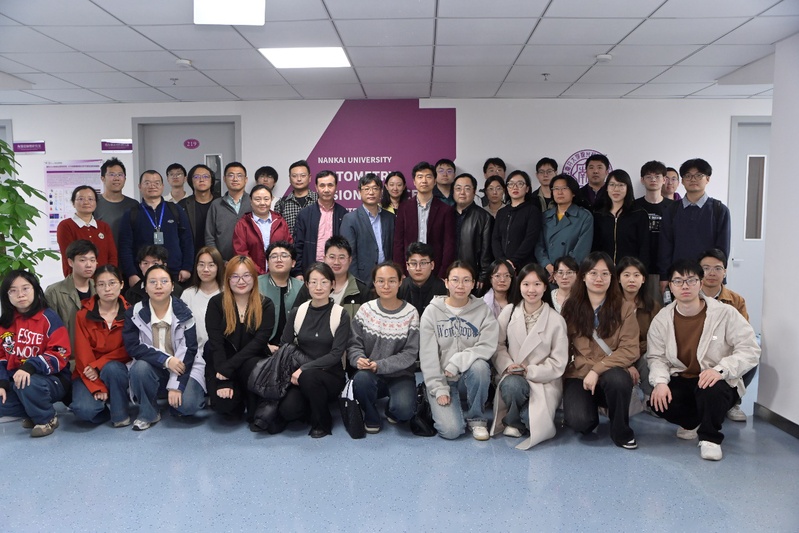
On the afternoon of March 26, 2026, Professor Liu Baohua from the University of Toronto, Canada, visited the School of Medicine, NKU for academic exchange and delivered an academic report entitled Deciphering the Role of Brainstem Inhibitory Neurons in Visual Motion Processing. The report was chaired by Professor Shi Xuefeng from Tianjin Eye Hospital Affiliated to NKU. Faculty and students from various schools, colleges, and institutes of NKU and other universities attended the lecture, including the School of Medicine of NKU, the Medical School of Tianjin University, Tianjin Eye Hospital Affiliated to NKU, Tianjin Medical University Eye Hospital, the School of Basic Medical Sciences of Tianjin Medical University, the School of Physics of NKU, the College of Artificial Intelligence of NKU, and the School of Electrical and Information Engineering of Tianjin University.
Li Lihua, Vice Dean of NKU Optometry & Vision Science Institute, extended a warm welcome to Professor Liu Baohua on behalf of the School and introduced the Institute. She expressed the hope that Professor Liu’s visit would further foster innovation and collaboration at the Institute in vision science.
In his presentation, Professor Liu focused on the essential role of brainstem inhibitory neurons in visual motion processing. Drawing on the latest findings of his research team, he offered an enlightening, easy-to-follow talk for faculty and students present. He noted that the brainstem receives dense afferent projections from the retina and plays a pivotal part in a wide spectrum of visual functions from reflexive behaviors to visual perception. Notably, visual nuclei in the brainstem contain a high proportion of GABAergic inhibitory neurons, which give rise to local and long-range inhibitory projections. Employing an array of advanced neural circuit analysis tools, including optogenetic manipulation, in vivo and in vitro electrophysiological recording, neural tracing and behavioral assays, Professor Liu’s team uncovered how inhibitory neurons in the nucleus of the optic tract shape the response properties of excitatory neurons within the nucleus as well as the tuning characteristics of the optokinetic reflex (OKR). The team also explored how inhibitory projections from the nucleus of the optic tract to the superior colliculus modulate neural activity in the superior colliculus and visual perception against moving backgrounds. These findings offer new insights into the mechanisms whereby inhibitory neurons in brainstem circuits regulate reflexive behaviors and visual perception.
The lecture drew faculty and students from disciplines including medicine, optical engineering, neural engineering, artificial intelligence and biomedical engineering from three Double First-Class universities in Tianjin, demonstrating the interdisciplinary nature of optometry and vision science research.
Amid an animated atmosphere, attendees engaged in in-depth discussions with Professor Liu, who patiently answered questions and shared valuable perspectives on cutting-edge issues in this field. This academic exchange has helped faculty and students gain new global perspectives in visual neuroscience and paved the way for future exchanges and collaboration with the University of Toronto in research and talent development.

Contact US
The School of Medicine, Nankai University 94 Weijin Road, Tianjin, 300071, China
TEL:86 (22) 2350-2554
38 Tongyan Road, Jinnan District, Tianjin, P.R.China 300350


